C’era una volta una montagna molto alta sulla cui cima era adagiata una casetta bianca dentro cui vi erano tre stanze.
In una di queste viveva Bruno, un bimbo allegro che non parlava mai.
I genitori di Bruno non sapevano spiegarsi il perché il piccolo tardasse tanto ad emettere la prima parola, un ‘mamma’ od un ‘papà’, sarebbe bastato a tranquillizzarli ma, Bruno, non faceva altro che sorridere, sfogliare libri nella sua stanza dentro la piccola casa sull’alta montagna e giocare con Pongo, il cucciolo di alce che viveva nel bosco dietro casa.
Bruno e Pongo erano inseparabili, tanto che i genitori dell’uno e dell’altro pensavano fossero fratelli, caduti per errore da un’unica stella che nel rimbalzo sulla terra si era spezzata in due, finendo nella pancia di due mamme anziché una sola.
Cosa fanno un alce ed un bimbo per divertirsi, vi chiederete?
Di buon mattino, subito dopo colazione, Bruno aiutato dal papà si vestiva di tutto punto e raggiungeva Pongo che lo aspettava sul limitare del bosco ed insieme si addentravano tra gli alberi, raccogliendo pigne che poi Pongo mangiava per merenda o foglie che Bruno collezionava affascinato dalla loro forma sempre diversa, di albero in albero. E poi d’estate andavano al ruscello che scorreva limpido nel cuore del bosco e nuotavano giocando a schizzarsi o a fare il morto a galla.
Il tempo passava sulla montagna e Bruno e Pongo erano felici di quel rapporto tanto speciale che non aveva bisogno di parole.
L’alce cresceva e con lui i suoi palchi che come rami gli spuntavano fuori dalla testa arricchendosi ogni mese che passava di nuove diramazioni.
Il papà di Bruno le chiamava corna e scherzava sul fatto che prima o poi sarebbero cresciute anche a Bruno se non avesse smesso di passare tutto il suo tempo con l’alce!
Il piccolo sorrideva sperando in cuor suo che accadesse davvero, che un giorno si sarebbe svegliato ed i suoi sogni, i più belli, quelli che avrebbe voluto trattenere durante la notte non volendolo abbandonare restassero con lui, ramificandosi sulla sua testolina pensosa, piena di prodigi e di misteri silenziosi, divenendo i palchi che tanto ammirava nel suo amico.
Dal canto suo però, Bruno non cresceva affatto, restava assai piccolo, gambe corte e viso tondo, muto come la neve che cade sulla montagna d’inverno.
Arrivò il momento per il bimbo di andare a scuola: lontano, in fondo alla montagna, un’altra casa ospitava una nuvola di bambini tutti seduti su sedie incastrate di fronte a banchi verdi e freddi, pronti ad imparare le cose del mondo.
Bruno avrebbe voluto parlarne a Pongo ma senza parole è difficile spiegare quel senso di tonfo in fondo allo stomaco che si prova quando si è chiamati a qualcosa di nuovo di cui non si sa proprio nulla.
“Vedrai, sarà divertente”, gli ripeteva il padre accompagnandolo, “conoscerai tanti bambini come te e sono sicuro che inizierai a parlare senza fermarti più!”
Il bimbo guardava fuori dal finestrino la sua casa farsi sempre più piccola ed immaginava Pongo giocare a creare piccoli disegni con la zampa spostando l’erbetta in attesa che il suo amico arrivasse per vivere una delle loro giornate avventurose.
Ma nulla, Bruno non arrivava e Pongo sconsolato tornava nel bosco senza avere il coraggio di raggiungere la casetta e sbirciare dalla finestra della sua stanza.
Il bambino si trovò a condividere il banco con la bimba più chiacchierona dell’universo: le sedie ed il banco erano altissime per lui che faceva una gran fatica ad arrampicarsi e posizionarsi, mentre lei, curiosa e svelta come un picchio, continuava a tamburellarlo di parole su come dovesse fare questo o quello e lo seguiva con lo sguardo come lui e Pongo facevano con le formiche quando trasportano un grande peso verso la loro tana.
Al ritorno, stanco, il piccolo guardava verso il bosco ma il suo amico non c’era e triste si metteva dietro la finestra sperando che prima o poi comparisse come per magia.
I giorni passarono, forse mesi: il tempo per gli alci ed i bimbi, infatti, è diverso da quello degli orologi degli adulti; è fatto di maglioni che pungono in ore che paiono infinite e poi brevissimi secondi di sole e bagni che i grandi invece chiamano ‘bella stagione’.
Il papà di Bruno sbagliava, malgrado la scuola, le chiacchiere continue della compagna di banco, la dolcezza malinconica della maestra assonnata che parlava di lettere fluttuanti su una grande lavagna e numeri stretti stretti in quadratini grigi sul foglio, nessuna parola sembrava voler saltar fuori dalla bocca di Bruno, ormai non più sorridente ma chiusa in un broncio di incomprensione e solitudine.
Finalmente arrivarono le vacanze ed un giorno svegliandosi il bimbo si accorse che non c’era nessun minaccioso grembiulino ad attenderlo sulla sedia di fianco al letto ma solo un paio di bermuda ed una maglietta a righe.
Si vestì in un balzo, fece colazione e raggiunse l’ingresso del bosco: il momento era giusto, mattina, che per lui voleva dire sole caldo senza ombre ma che ancora non scotta e giusto era il posto, terzo albero dalle foglie a forma di zampa d’anatra ma Pongo non c’era.
Aspettò, il sole si fece caldo ma Bruno non ci faceva caso, o meglio, vedeva le onde di calore coprire tutto eppure lui era sempre in ombra: camminava, raccoglieva fiori nel prato per la mamma, tornava indietro, si addentrava appena nel bosco ma l’ombra era sempre con lui.
Pongo invece no.
Non arrivò né quel giorno né quello successivo.
“Mi ha dimenticato!”, sospirò. Ed il tonfo allo stomaco che aveva sentito il primo giorno di scuola tornò arricchendosi di una freccia che appuntita lo trafiggeva dovunque, ancora ed ancora.
Allora iniziò a tremare tutto e gli parve che un ruscello, tale e quale a quello in cui giocava nel bosco con Pongo, gli crescesse dentro, ansioso di scorrere fuori, provò a trattenerlo ma non ci fu verso, straripò.
Chiunque passasse di lì in quel momento avrebbe visto solo un bimbo dalle gambe corte che in mezzo ad un prato piangeva, sotto un cielo che andava velocemente riempendosi di nuvole come accade spesso in montagna.
All’improvviso, un tuono e poi la pioggia che generosa bagna tutto.
Tutto eccetto Bruno.
All’inizio il bimbo si stropicciò gli occhi ancora pieni di lacrime e pensò che forse il cielo vedendolo così triste avesse voluto risparmiarlo dalla sue gocce ma poi guardando a terra capì che anche il terreno attorno a lui per una parte era asciutto.
Così iniziò a camminare ma ancora la pioggia non lo bagnava; allora corse facendo scatti improvvisi ma nulla, restava asciutto.
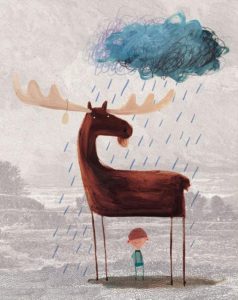
Fu allora che alzò la testa e vide un grande ombrello marrone di pelo, no, era una pancia, una grande pancia marrone e pelosa e più distante, due zampe e due lunghe gambe, davanti e dietro.
Come aveva potuto non notarle prima?
“Pongo!”, esclamò e si coprì di colpo la bocca, sorpreso da quell’ urlo di gioia che lui stesso aveva pronunciato e che non partiva dalla gola ma da un posto più prezioso e delicato: il suo piccolo cuore.
L’alce era cresciuto divenendo immenso rispetto al bimbo, incapace di parlare ed intimidito dalla sua possente crescita temendo di spaventare il suo amico non aveva potuto avvisarlo della sua presenza ma lo seguiva da giorni proteggendolo dal sole ed ora dalla pioggia che aveva appena smesso di cadere, sorpresa anch’essa dalla voce di Bruno.
Così il bambino osservò il suo amico ritrovato, i palchi sulla sua testa erano cresciuti tantissimo: spessi, ramificati, avvolti in un tenero velluto, affascinavano Bruno che sapeva decodificarli, riuscendo a capire quale sogno raccontasse ogni centimetro, ogni curva.
Vide l’incubo dell’alce di aver perso l’amico, si commosse di fronte al sogno di incontrarlo ancora, rise del sogno di loro insieme a scuola, l’alce seduto di fianco a lui nel banco.
Erano gli stessi sogni che il bambino aveva fatto in quei mesi, gli stessi solo più reali perché rimasti impressi nei palchi sulla testa ormai cresciuta del suo amico a quattro zampe.
Corsero insieme a casa, condivisero una merenda di pigne, muschi e pane e marmellata ed alla fine della giornata, Bruno sfoggiò la sua capacità di giovane scrittore, scrivendo ‘Pongo’ su un foglietto che appese su un palco dell’alce.
Ormai non importava più se c’era il sole o pioveva, Bruno sapeva che Pongo l’avrebbe sempre protetto e lui, di rimando, che grazie alla gioia di aver ritrovato il suo amico aveva conquistato la sua voce, non mancava di chiamarlo a squarciagola quando tornava da scuola e di raccontargli le cose del mondo che imparava.
Traduzione in francese:
Il était une fois une montagne très haute, à la cime de laquelle était posée une petite maisonnette dans laquelle y avaient trois chambres.
Dans une de celle ci vivait Bruno, un garçon jovial qui ne parlait jamais.
Les parents de Bruno ne savait pas s’expliquer pourquoi le petit tardait autant à émettre son premier mot, un “maman” ou un “papa” qui aurait suffit à les rassurer mais Bruno ne faisait que sourire, feuilleter des bouquins dans sa chambre de la petite maisonnette posée sur la montagne, et jouer avec Pongo, le bébé élan qui vivait dans les bois derrière la maison.
Bruno et Pongo étaient inséparables, si bien que les parents, aussi bien l’un que l’autre, pensaient qu’ils étaient frères, tombés par erreur d’une étoile qui, en rebondissant sur terre, s’était cassée en deux, et retrouvés dans le ventre de deux mamans, au lieu d’une.
Qu’est-ce que un élan et un enfant font pour s’amuser, vous vous demandez? Tôt le matin, après le petit déjeuner, Bruno, aidé par son papa, se tirait à quatre épingles et rejoignait Pongo qui l’attendait sur le bord de la forêt et, ensemble, ils pénétraient sous les arbres, cueillant des pommes de pin qu’ensuite Pongo mangeait au gouter, ou des feuilles que Bruno collectionnait, d’arbre en arbre, fasciné par leur forme toujours différente. Et puis l’été ils allaient au ruisseau qui courait limpide au cœur de la forêt et nageaient, jouaient à s’éclabousser ou à faire le mort à flot. Le temps passait sur la montagne et Bruno et Pongo étaient heureux de cette relation si particulière qui n’avait pas besoin de mots. L’élan grandissait et avec lui les bois qui comme des branches lui jaillissaient de la tête, en s’enrichissant à chaque mois qui passait de nouvelles ramifications.
Le père de Bruno les appelait des cornes et plaisantait sur le fait que tôt ou tard elles auraient poussées à Bruno également, s’il n’arrêtait pas de passer tout son temps avec l’élan.
Le petit souriait, espérant dans son cœur que cela arrive vraiment, qu’un jour il se réveille et ses rêves les plus beaux, ceux qu’il aurait voulu garder durant la nuit, ne voulant pas l’abandonner, restent avec lui, se développant sur sa tête pensive, pleine de prodiges et de mystères silencieux, devenant les bois qu’il admirait tant sur son ami.
De son côté cependant, Bruno ne poussait pas du tout, il restait assez petit, jambes courtes et visage rond, muet comme la neige qui tombe sur la montagne en hiver.
Il arriva pour l’enfant le moment d’aller à l’école : loin, au fond de la montagne, une autre maison accueillait une nuage d’enfants tous assis sur les chaises coincées entre des bureaux verts et froids, prêts à apprendre les choses du monde.
Bruno aurait voulu en parler à Pongo, mais sans parole il est difficile d’expliquer cette sensation de boule dans l’estomac que l’on éprouve lorsqu’on est embarqué dans quelque chose de nouveau dont on ignore tout.
“Tu verras ce sera amusant”, lui répétait son père en l’accompagnant, “tu rencontreras plein d’enfant comme toi et je suis certain que tu commenceras à parler sans jamais t’arrêter”.
L’enfant regardait au dehors par la petite fenêtre sa maison devenir de plus en plus petite et imaginait Pongo qui s’amusait à faire de petits dessins avec sa patte sur l’herbe, en attendant que son ami arrive pour vivre une de leurs journées d’aventure.
Mais non. Bruno n’arrivait pas et Pongo dépité repartait dans le bois sans avoir le courage de rejoindre la petite maison et épier par la fenêtre de sa chambre.
L’enfant partageait son banc avec la fille la plus bavarde de l’univers : les chaises et le banc étaient très hauts pour lui et il y grimpait et s’y arrangeait avec difficulté tandis qu’elle, curieuse et agile comme un pic-vert, le martelait de paroles ininterrompues sur la manière de faire ceci ou cela, et ne le lâchait pas du regard comme quand lui et Pongo observait les fourmis qui transportaient un poids important vers leur tanière.
Au retour, fatigué, le petit regardait vers le bois mais son ami n’était pas là et, attristé, il se mettait derrière la fenêtre espérant qu’à un moment à l’autre il apparaisse comme par magie.
Les journées passaient, peut-être des mois : le temps pour les élans et les enfants, en effet, est différent de celui des horloges des adultes ; il est fait de pullovers qui se tricotent durant des heures interminables, et puis de brèves secondes de soleil et de bains que les grands appellent au contraire la “belle saison”. (ou “il est fait de pullovers qui se piquent durant des heures infinies”).
Le papa de Bruno avait tort. Malgré l’école, les bavardages incessants de la camarade de banc, la douceur mélancolique de la maitresse somnolente, qui parlait de lettres fluctuant sur un grand tableau et de nombres à l’étroit dans de petits carrés gris sur la feuille, aucun mot ne semblait vouloir sortir de la bouche de Bruno, non plus souriante mais refermée dans une moue d’incompréhension et de solitude.
Finalement les vacances arrivèrent et un jour, en s’éveillant, l’enfant se rendit compte que le tablier menaçant qui l’attendait sur la chaise à côté de son lit était remplacé par une paire de bermuda et un T-shirt à rayures.
Il s’habilla en un éclair, petit déjeuna et se rendit à l’entrée du bois : le moment était propice, de matin, qui pour lui signifiait un soleil chaud, sans ombre, mais qui ne brûlait pas encore, et l’endroit était le bon, troisième arbre avec les feuille en forme de patte de canard, mais Pongo n’était pas là.
Il attendit, le soleil se fit plus chaud, mais Bruno n’y prêtait pas attention, ou encore mieux, il voyait les ondes de chaleur tout recouvrir mais lui restait toujours à l’ombre : il marchait cueillait des fleurs pour sa maman dans le pré, revenait sur ses pas, pénétrait à peine dans le bois et l’ombre était toujours avec lui.
Mais Pongo non.
Il ne vint pas de la journée, ni la suivante.
“Il m’a oublié !”, soupira-t-il. Et la boule à l’estomac qu’il avait ressenti le premier jour d’école revint, accompagnée d’une flèche acérée qui le transperçait partout, encore et encore.
Il commença alors à trembler dans tout son corps et il lui sembla qu’un ruisseau, comme celui dans lequel il jouait dans le bois avec Pongo, grandissait en lui, impatient de s’écouler au dehors, il essaya de le contenir, mais sans y parvenir et déborda.
Quiconque serait passé par là à ce moment aurait seulement vu un garçonnet aux jambes courtes, pleurant au milieu d’un pré, sous un ciel qui s’emplissait rapidement de nuages comme il arrive souvent en montagne.
Soudain, un coup de tonnerre, et puis une pluie abondante qui détrempa tout.
Tous sauf Bruno
Le garçonnet commença à se frotter les yeux encore plein de larmes, pensant que le ciel, en le voyant si triste, avait voulu lui faire épargner quelques gouttes, puis, regardant par terre, il compris que le sol autour de lui était en partie sec.
Ainsi, il commença à marcher, mais la pluie le mouillait toujours; et alors il courra en faisant des bonds rapides mais rien, il restait sec.
C’est alors, que levant la tête, il vit un grand parapluie de poils marrons, non, c’était un ventre, un gros ventre marron et poilu et, plus loin, deux longues jambes, devant, et derrière.
Comment ne l’avait il pas remarqué avant ?
“Pongo !” s’exclama-t-il, et il se couvrit soudainement la bouche, surprit de ce cri de joie qu’il avait lui même prononcé, et qui partait non pas de sa gorge, mais d’un lieu plus précieux et délicat : son petit cœur.
L’élan avait grandi, devenant immense par rapport au garçon, et incapable de parler, intimidé par sa forte croissance et craignant d’effrayer son ami, il n’avait pu l’avertir de sa présence, mais le suivait depuis des jours, le protégeant du soleil et maintenant de la pluie qui venait de s’arrêter, elle même surprise par la voix de Bruno.
Le garçonnet observait ainsi son ami retrouvé. Les bois sur sa tête avaient énormément grandi, épais, et se ramifiaient, recouverts d’un tendre velours, il fascinaient Bruno qui savait les décoder, et comprenait quel songe racontait chaque centimètre, chaque courbe.
Il compris le cauchemar pour l’élan d’avoir perdu son ami, s’émouva encore devant le songe de leur rencontre, rit du rêve d’eux ensemble à l’école, l’élan assis à côté de lui sur le banc.
C’étaient les mêmes rêves que le garçonnet avait fait ces derniers mois, identiques mais en plus réels car ils étaient restés imprimés sur les bois, de la tête désormais grande de son ami à quatre pattes.
Ils coururent ensemble jusqu’à la maison, partageant un goûter de pommes de pin, de mousse, de pain et de confiture, et à la fin de la journée, Bruno avec fierté mis en œuvre ses capacités de jeune écrivain, traçant “Pongo” sur un feuillet qu’il suspendit sur l’un des bois de l’élan.
Désormais il n’importait plus qu’il y ait du soleil ou qu’il pleuve, Bruno savait que Pongo le protégerait toujours et lui, en retour, ayant conquis sa voix grâce à la joie d’avoir retrouvé son ami, ne manquait pas de l’appeler à tue-tête quand il revenait de l’école, et de lui raconter les choses du monde qu’il avait apprises.
Traduzione in inglese:
Once upon a time there was a very high mountain, on top of which there was a white little house with three rooms inside.
In one of this rooms lived Bruno, a cheerful baby that never spoke.
Bruno’s parents cannot explain why the baby was so late to issue the first word, a “mummy” or “daddy” would have been enough to calm them, but Bruno did nothing but smile, browse books in his room within the little house on the high mountain and play with Pongo, the puppy moose that lived in the forest behind the house.
Bruno and Pongo were inseparable, as long as the parents of both thought that they were brothers, fallen by mistake from the same star that, in the bounce on earth, broke in two, landing in the belly of two mothers instead of one.
What can do a moose and a child to have fun together, you would ask?
In the early morning, right after breakfast, Bruno, helped from his father, dressed and reached Pongo, that was waiting for him at the edge of the forest and together penetrate into the trees collecting pine cones, that Pongo would eat later for a snack or leaves that Bruno collected, charmed by their shape, tree by tree different.
And then in summer they went to the stream that flowed clear in the heart of the wood and swam, splashed or played dead afloat.
Time went by on the mountain and Bruno and Pongo were happy of that so special relationship that has no need of words.
The moose grow and with him grow his antlers, that tick off his head as branches, getting rich of new branches month by month.
Bruno’s father called them horns, joking on the fact that, sooner or later, they would have grown on the head of Bruno as well, if he wouldn’t have stopped to pass all of his time with the moose!
The baby smiled, hoping in his heart that this would really happen, that one day he would wake up and all of his dreams, the most beautiful, the ones that he would keep during all night long, stayed with him, branching out on his thoughtful little head, full of wonders and silent mysteries, becoming the branches that he admired so much in his friend.
From his side, instead, Bruno did not grow at all, he remained very small, short leg and round face, speechless as the snow that fall on the mountain in winter.
Then comes the time for the child to go to school: far away, down the mountain, another home hosted a cloud of babies, all sitting on chairs wedged in front of green and cold desks, ready to learn the things of the world.
Bruno would have talk to Pongo about it but without words it’s difficult to explain that sense of thud at the bottom of the stomach that you feel when you have been called on to something new that you do not know at all.
“You’ll see, it will be funny”, repeated his father to him while driving him to school, “you will meet many children like you and I am sure that you’ll start speak without stopping anymore!”.
The baby looked out of the window, his home becoming more and more small and imagined Pongo playing and create small drawings with the paw, by moving the grass waiting for his friend to live one of their adventurous day.
But nothing, Bruno did not come and Pongo, disconsolate, came back to the wood without having the courage to reach the small house and peek through the window of his room.
The child found himself sharing the desk with the most chatterer child in the universe: the chairs and the desk were very high for him, that was a real effort to climb and take place, while her, curious and fast like a woodpecker, kept stunning him of words on how he had to do this or that and follow him with her eyes just like him and Pongo did with the ants when they carried a big burden towards their den.
On the way back, tired, the child looked towards the woods but his friends was not there and, sad, he was put behind the window hoping that, sooner or later, he would appear by magic.
The days passed, maybe moths: the time for moose and child, indeed, is different from the adult’s watches; it’s made of sweaters that sting in hours that seems to be never ending and then short seconds of sun and bathes that adult people call “beautiful season”, instead.
Bruno’s father was wrong, despite the school, the constant chatter of the classmate, the melancholy sweetness of the sleepy teacher that talked about floating letters on a big blackboard and tight numbers within grey squares on the sheet, no words seemed to want to jump out of Bruno’s mouth, now smiling no more but closed in a pout of misunderstanding and solitude.
Finally came the holidays and one day, awaking, the baby realized that there was no threatening school dress to wait for him on the chair next to his bed, but only a pair of shorts and a striped shirt.
He dressed in a jump, had breakfast and reached the entrance of the forest: the moment was right, the morning, that for him meant warm sun without shadows but still not hot and right was the place, third tree with leg of duck shaped leaves, but Pongo was not there.
He waited, the sun grew hot but Bruno took no notice, or better, he saw the heat weaves cover everything, but he was always in the shade: he walked, picking flowers in the meadow for his mother, went back, he penetrated into the woods but the shadow was always with him.
Pongo will no.
He did not come neither next day, nor the next one.
“He has forgotten me!”, he sighed.
And the thud at the stomach that he felt the first day of school returned again, enriched of a pointed arrow that pierced him everywhere, again and again.
Then he began to tremble all over and he thought that a stream, as such to that where he played in the woods with Pongo, grew inside him, eager to flow outside, he tried to hold it back but there was no way, it overflowed.
Everyone who passed by there in that moment would have seen only a short leg child that cried in the middle of a meadow, under a sky that was going to fill with clouds as often happens in the mountains.
Suddenly a thunder, then the rain that generously wet all over.
Everything but Bruno.
At the beginning the child rubbed his eyes still full of tears and thought that, maybe, the sky, seen him so sad, would have saved him from his drops, but then, looking down, he understood that the ground around him was dry as well.
So he started walking but still the rain did not wet him. So he ran by sudden bursts but nothing, he remained dry.
It was then that he raised his head and saw a big brown hairy umbrella, no, it was a belly, a big brown hairy belly and, farther, two paws and two long legs, front and back.
How could he have not noticed them before?
“Pongo!”, he exclaimed and suddenly covered his mouth, surprised from that shout of joy that himself had pronounced and that would not came out from the throat but from a more precious and delicate place: his little heart.
The moose had grown, becoming huge in comparison to the child, unable to speak and intimidated from his mighty growth and afraid to scare his friend, could not noticed him about his presence but follow him for days, protecting him from the sun and now from the rain, that has stopped to fall, surprised from the voice of Bruno as well.
So the baby watched his rediscovered friend, the antlers on his head had grown so much: thick, branched, wrapped in a soft velvet, they fascinated Bruno that knew how to decode them, understanding what dream would tell every centimeter, every curve.
He saw the nightmare of the moose to have lost his friend, he moved in front of the dream to meet him again, laughed of the dream of them together at school, the moose sit next to him in the desk.
They were the same dreams that the child had dreamed in those months, the same only more real because marked in the horns on the head grew big of his four-legged friend.
They ran home together, shared a snack of folds, mosses and bread and jam and, at the end of the day, Bruno showed off his ability of young writer, by writing “Pongo” on a slip of paper that hanged on a horn of the moose.
By now it did not matter if there was the sun or rain, Bruno knew that Pongo would have always protected him and him, back, that thank to the joy of finding again his friend gained his voice, did not fail to call him loudly when he came back from school and to tell him the things of the world that he learned.
Fiaba bellissima, l’amicizia è un dono prezioso!
Grazie Noemi, a presto con nuove storie ispirate ad illustrazioni!
Una fiaba bellissima, mi ha emozionata e teneramente commossa . Grazie
Grazie a te, Luce, è bello sapere di essere letta da anime delicate capaci di emozionarsi con le mie fiabe.
Fiaba bella e tenera
l’ amitié, bien le plus précieux
Fiaba emozionante.